Mission
The MHL is committed to supporting a hands-on experience for engineering students at the University of Michigan. We are also committed to providing a quality testing facility for professors and researchers at the University of Michigan as well as industry and government sponsored programs.
Experiential laboratory work is a focus of the NA&ME program. The MHL and its staff play a key role in getting students this vital hands-on experience. The following courses have lab elements that take place at the MHL.
Education
Engr 100, Intro to Engineering
Engr 100 is a required course of all first-year engineers. The NA&ME Department hosts one section of Engr 100 in each of the fall and winter terms. During the semester, students come to the MHL to perform a ship resistance test and later return to test their own designed and built Remote Operated Vehicles (ROVs).
NA 320, Marine Hydrodynamics I
NA 320 is a required course for NA&ME students and is typically taken in the junior year. Students in NA 320 come to the MHL for a waterjet propulsion system lab.
NA 321, Marine Hydrodynamics II
NA 321 is a required course for NA&ME students and is typically taken in the junior year. Students in NA 321 come to the MHL for a ship resistance test.
NA 491 & NA 492, Marine Engineering Laboratory I & II
NA 491 & NA 492 are required courses for NA&ME students and are typically taken in the senior year. These labs take place at the MHL and provide students with thorough instruction in laboratory techniques and instrumentation and the use of computers in data analysis, including Fast Fourier transforms. Students investigate fluid concepts, hydro-elasticity, marine dynamics, propeller forces, wave mechanics, ship hydrodynamics, and the extrapolation of model tests to full scale results.
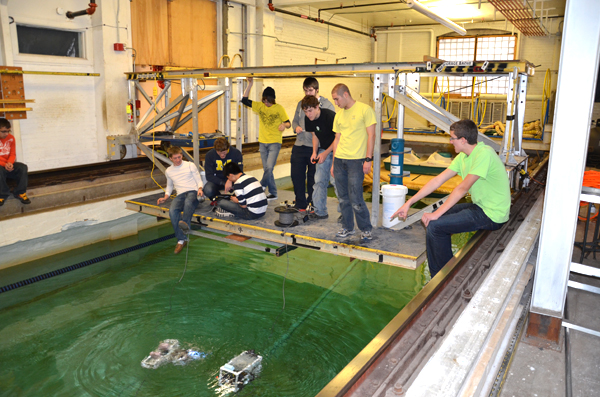
Engr 100 students testing their ROVs.
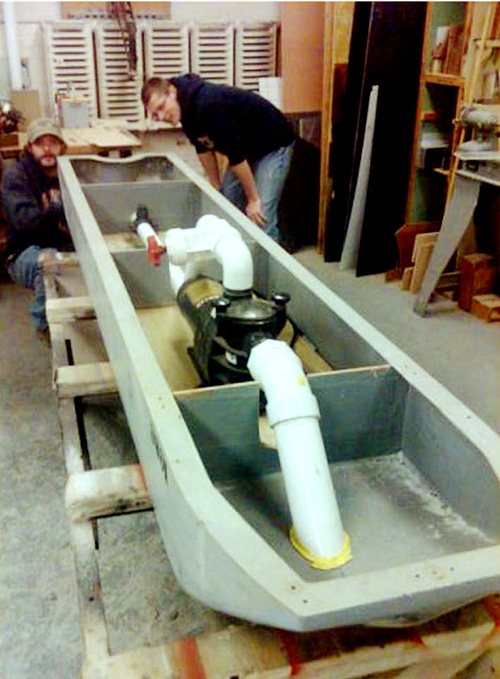
Model setup for waterjet propulsion lab in NA 320
Research
The MHL is a unique facility that hosts research projects by professors and students in the NA&ME Department. The staff provides technical guidance and support in experiment design, instrumentation use and design, and conducting the experimental tests.
Industry and Government Sponsored Work
The MHL hosts a variety of industry and government sponsored work programs. We have partnered with state and federal level agencies involved in defense, the environment, and education. We have also conducted commercial testing for business organizations ranging from individual entrepreneurs to major corporations.
History
The Naval Architecture & Marine Engineering (NA&ME) Department has its roots in an 1879 act of Congress, which authorized the U. S. Navy to assign a few officers to engineering colleges around the country. Mortimer E. Cooley, an 1878 Naval Academy graduate, voiced an interest and was accordingly sent to the University of Michigan to teach “steam engineering and iron shipbuilding.” Upon his arrival he was one of but four professors of engineering at the University, at that time a department within the College of Literature, Science, and the Arts. The Naval Architecture and Marine Engineering (NA&ME) Department was officially established in 1881.
In 1899, the University of Michigan Regents appropriated $2000 to establish a curriculum in naval architecture and marine engineering. Cooley was told to find a professor of naval architecture while he himself was to continue teaching marine engineering. Simultaneously, a major new building was being designed to house engineering classrooms, offices, and laboratories. With an eye to attracting the best possible academician to teach naval architecture, Cooley integrated into the foundation of the new building a large model basin for scientific testing and development of ships’ hull forms. The building, named the West Engineering Building, opened in 1904.
In 1957, Richard B. Couch was induced to leave his position as Chief Naval Architect with the Navy Department’s Bureau of Ships to become Chair of the NA&ME department. He brought with him ambitious plans for improving the scope of the educational program and the capabilities of the model basin. Couch induced the College of Engineering to invest heavily in a new carriage and sophisticated instrumentation for the model basin, which now took on a more suitable designation as the Ship Hydrodynamics Laboratory. Couch was fortunate in that his arrival coincided with the Soviet Union’s Sputnik I, and with it a renewed national interest in science and engineering, which reflected in generous financial support for our department. Couch’s modernized Ship Hydrodynamics Laboratory became so much in demand for all manner of commercial testing that at times it had to operate two daily shifts.
In 1977, Chair T. Francis Ogilvie moved the NA&ME department to its current location on North Campus. The Ship Hydrodynamics Laboratory and attendant facilities remained on Central Campus as the renamed the Marine Hydrodynamics Laboratory located in West Hall (formerly West Engineering). Following extensive experimental programs through the 1990’s, the towing tank was cleaned and refurbished in 2006.